 Add to Chrome
 Add to Firefox
 Add to Edge
LATTE: Forecasting Peer Anchored Preference Trajectories for Personalized LLM Generation
May 26, 2026
Personalized generation with frozen large language models requires a conditioning signal that is both compact and current. Existing personalization methods typically retrieve or summarize user histories in text, or compress them into static latent profiles and soft prompts. These approaches are efficient, but they treat a user's past behavior as an aggregate profile and therefore mix stable identity, recent drift, and item content in the same representation. We propose LAtent Trajectory Tracking and Extrapolation (LATTE), a framework that represents personalization as forecasting a peer anchored relative preference state. For each historical session, LATTE subtracts a time masked baseline formed from comparable users who responded to the same item, producing a state that measures how the target user differs from peers under a shared item context. A lightweight sequence predictor then forecasts the next state in this trajectory, and a State to Token Bridge injects the forecast into a frozen instruction tuned LLM through a single anchored soft token. We provide a latent factor analysis showing when peer anchoring cancels shared item variation and why temporal forecasting trades off stale averages against noisy recent states. Experiments on Amazon Reviews 2023 and MemoryCD show that LATTE consistently outperforms retrieval, summary memory, static latent profiles, difference aware latent profiles, and soft prompt compression baselines. On Amazon Reviews 2023, LATTE improves average ROUGE-L from 0.219 for a static latent profile and 0.245 for the strongest added latent compression baseline to 0.259. Additional pairwise comparisons and diagnostic analyses suggest that the improvement is mainly due to forecasting user-specific trajectory information, rather than merely adding a soft prompt interface.

Beyond the Target: From Imitation to Collaboration in Speculative Decoding
May 24, 2026Speculative decoding (SPD) accelerates large language model (LLM) inference by letting a smaller draft model propose multiple future tokens that are verified in parallel by a larger target model. The dominant SPD paradigm treats the target model as the sole reliable teacher, accepting a draft token only when it exactly matches the target prediction. This design implicitly assumes that the target is always the better choice at every position. In practice, this assumption does not hold. Although the draft is the weaker model overall, it is not uniformly inferior at the token level. In a meaningful fraction of cases where draft and target disagree, the draft's choice is the one that leads to the correct final answer. Inspired by this, we introduce \textbf{Collaborative Speculative Decoding (CoSpec)}, a generalization of SPD that no longer treats the target model as the sole token-level authority. CoSpec trains an arbitration policy via reinforcement learning to decide whether to accept tokens from the draft or target model, selectively accepting draft tokens at mismatches when doing so is likely to yield a correct final answer. Experimental results show that CoSpec maintains substantial speedups while surpassing target-only performance. By shifting the emphasis from imitation to collaboration, CoSpec suggests a new perspective on speculative decoding.
Well Begun is Half Done: Training-Free and Model-Agnostic Semantically Guaranteed User Representation Initialization for Multimodal Recommendation
Apr 16, 2026Recent advancements in multimodal recommendations, which leverage diverse modality information to mitigate data sparsity and improve recommendation accuracy, have gained significant attention. However, existing multimodal recommendations overlook the critical role of user representation initialization. Unlike items, which are naturally associated with rich modality information, users lack such inherent information. Consequently, item representations initialized based on meaningful modality information and user representations initialized randomly exhibit a significant semantic gap. To this end, we propose a Semantically Guaranteed User Representation Initialization (SG-URInit). SG-URInit constructs the initial representation for each user by integrating both the modality features of the items they have interacted with and the global features of their corresponding clusters. SG-URInit enables the initialization of semantically enriched user representations that effectively capture both local (item-level) and global (cluster-level) semantics. Our SG-URInit is training-free and model-agnostic, meaning it can be seamlessly integrated into existing multimodal recommendation models without incurring any additional computational overhead during training. Extensive experiments on multiple real-world datasets demonstrate that incorporating SG-URInit into advanced multimodal recommendation models significantly enhances recommendation performance. Furthermore, the results show that SG-URInit can further alleviate the item cold-start problem and also accelerate model convergence, making it an efficient and practical solution for multimodal recommendations.
DBGL: Decay-aware Bipartite Graph Learning for Irregular Medical Time Series Classification
Apr 12, 2026Irregular Medical Time Series play a critical role in the clinical domain to better understand the patient's condition. However, inherent irregularity arising from heterogeneous sampling rates, asynchronous observations, and variable gaps poses key challenges for reliable modeling. Existing methods often distort temporal sampling irregularity and missingness patterns while failing to capture variable decay irregularity, resulting in suboptimal representations. To address these limitations, we introduce DBGL, Decay-Aware Bipartite Graph Learning for Irregular Medical Time Series. DBGL first introduces a patient-variable bipartite graph that simultaneously captures irregular sampling patterns without artificial alignment and adaptively models variable relationships for temporal sampling irregularity modeling, enhancing representation learning. To model variable decay irregularity, DBGL designs a novel node-specific temporal decay encoding mechanism that captures each variable's decay rates based on sampling interval, yielding a more accurate and faithful representation of irregular temporal dynamics. We evaluate the performance of DBGL on four publicly available datasets, and the results show that DBGL outperforms all baselines.
Verify Before You Commit: Towards Faithful Reasoning in LLM Agents via Self-Auditing
Apr 09, 2026In large language model (LLM) agents, reasoning trajectories are treated as reliable internal beliefs for guiding actions and updating memory. However, coherent reasoning can still violate logical or evidential constraints, allowing unsupported beliefs repeatedly stored and propagated across decision steps, leading to systematic behavioral drift in long-horizon agentic systems. Most existing strategies rely on the consensus mechanism, conflating agreement with faithfulness. In this paper, inspired by the vulnerability of unfaithful intermediate reasoning trajectories, we propose \textbf{S}elf-\textbf{A}udited \textbf{Ve}rified \textbf{R}easoning (\textsc{SAVeR}), a novel framework that enforces verification over internal belief states within the agent before action commitment, achieving faithful reasoning. Concretely, we structurally generate persona-based diverse candidate beliefs for selection under a faithfulness-relevant structure space. To achieve reasoning faithfulness, we perform adversarial auditing to localize violations and repair through constraint-guided minimal interventions under verifiable acceptance criteria. Extensive experiments on six benchmark datasets demonstrate that our approach consistently improves reasoning faithfulness while preserving competitive end-task performance.
CAMMSR: Category-Guided Attentive Mixture of Experts for Multimodal Sequential Recommendation
Mar 04, 2026The explosion of multimedia data in information-rich environments has intensified the challenges of personalized content discovery, positioning recommendation systems as an essential form of passive data management. Multimodal sequential recommendation, which leverages diverse item information such as text and images, has shown great promise in enriching item representations and deepening the understanding of user interests. However, most existing models rely on heuristic fusion strategies that fail to capture the dynamic and context-sensitive nature of user-modal interactions. In real-world scenarios, user preferences for modalities vary not only across individuals but also within the same user across different items or categories. Moreover, the synergistic effects between modalities-where combined signals trigger user interest in ways isolated modalities cannot-remain largely underexplored. To this end, we propose CAMMSR, a Category-guided Attentive Mixture of Experts model for Multimodal Sequential Recommendation. At its core, CAMMSR introduces a category-guided attentive mixture of experts (CAMoE) module, which learns specialized item representations from multiple perspectives and explicitly models inter-modal synergies. This component dynamically allocates modality weights guided by an auxiliary category prediction task, enabling adaptive fusion of multimodal signals. Additionally, we design a modality swap contrastive learning task to enhance cross-modal representation alignment through sequence-level augmentation. Extensive experiments on four public datasets demonstrate that CAMMSR consistently outperforms state-of-the-art baselines, validating its effectiveness in achieving adaptive, synergistic, and user-centric multimodal sequential recommendation.
DeepAFL: Deep Analytic Federated Learning
Feb 28, 2026Federated Learning (FL) is a popular distributed learning paradigm to break down data silo. Traditional FL approaches largely rely on gradient-based updates, facing significant issues about heterogeneity, scalability, convergence, and overhead, etc. Recently, some analytic-learning-based work has attempted to handle these issues by eliminating gradient-based updates via analytical (i.e., closed-form) solutions. Despite achieving superior invariance to data heterogeneity, these approaches are fundamentally limited by their single-layer linear model with a frozen pre-trained backbone. As a result, they can only achieve suboptimal performance due to their lack of representation learning capabilities. In this paper, to enable representable analytic models while preserving the ideal invariance to data heterogeneity for FL, we propose our Deep Analytic Federated Learning approach, named DeepAFL. Drawing inspiration from the great success of ResNet in gradient-based learning, we design gradient-free residual blocks in our DeepAFL with analytical solutions. We introduce an efficient layer-wise protocol for training our deep analytic models layer by layer in FL through least squares. Both theoretical analyses and empirical evaluations validate our DeepAFL's superior performance with its dual advantages in heterogeneity invariance and representation learning, outperforming state-of-the-art baselines by up to 5.68%-8.42% across three benchmark datasets.
Towards Pixel-Wise Anomaly Location for High-Resolution PCBA via Self-Supervised Image Reconstruction
Dec 22, 2025Automated defect inspection of assembled Printed Circuit Board Assemblies (PCBA) is quite challenging due to the insufficient labeled data, micro-defects with just a few pixels in visually-complex and high-resolution images. To address these challenges, we present HiSIR-Net, a High resolution, Self-supervised Reconstruction framework for pixel-wise PCBA localization. Our design combines two lightweight modules that make this practical on real 4K-resolution boards: (i) a Selective Input-Reconstruction Gate (SIR-Gate) that lets the model decide where to trust reconstruction versus the original input, thereby reducing irrelevant reconstruction artifacts and false alarms; and (ii) a Region-level Optimized Patch Selection (ROPS) scheme with positional cues to select overlapping patch reconstructions coherently across arbitrary resolutions. Organically integrating these mechanisms yields clean, high-resolution anomaly maps with low false positive (FP) rate. To bridge the gap in high-resolution PCBA datasets, we further contribute a self-collected dataset named SIPCBA-500 of 500 images. We conduct extensive experiments on our SIPCBA-500 as well as public benchmarks, demonstrating the superior localization performance of our method while running at practical speed. Full code and dataset will be made available upon acceptance.
Learning and Editing Universal Graph Prompt Tuning via Reinforcement Learning
Dec 09, 2025Early graph prompt tuning approaches relied on task-specific designs for Graph Neural Networks (GNNs), limiting their adaptability across diverse pre-training strategies. In contrast, another promising line of research has investigated universal graph prompt tuning, which operates directly in the input graph's feature space and builds a theoretical foundation that universal graph prompt tuning can theoretically achieve an equivalent effect of any prompting function, eliminating dependence on specific pre-training strategies. Recent works propose selective node-based graph prompt tuning to pursue more ideal prompts. However, we argue that selective node-based graph prompt tuning inevitably compromises the theoretical foundation of universal graph prompt tuning. In this paper, we strengthen the theoretical foundation of universal graph prompt tuning by introducing stricter constraints, demonstrating that adding prompts to all nodes is a necessary condition for achieving the universality of graph prompts. To this end, we propose a novel model and paradigm, Learning and Editing Universal GrAph Prompt Tuning (LEAP), which preserves the theoretical foundation of universal graph prompt tuning while pursuing more ideal prompts. Specifically, we first build the basic universal graph prompts to preserve the theoretical foundation and then employ actor-critic reinforcement learning to select nodes and edit prompts. Extensive experiments on graph- and node-level tasks across various pre-training strategies in both full-shot and few-shot scenarios show that LEAP consistently outperforms fine-tuning and other prompt-based approaches.
VI-MMRec: Similarity-Aware Training Cost-free Virtual User-Item Interactions for Multimodal Recommendation
Dec 09, 2025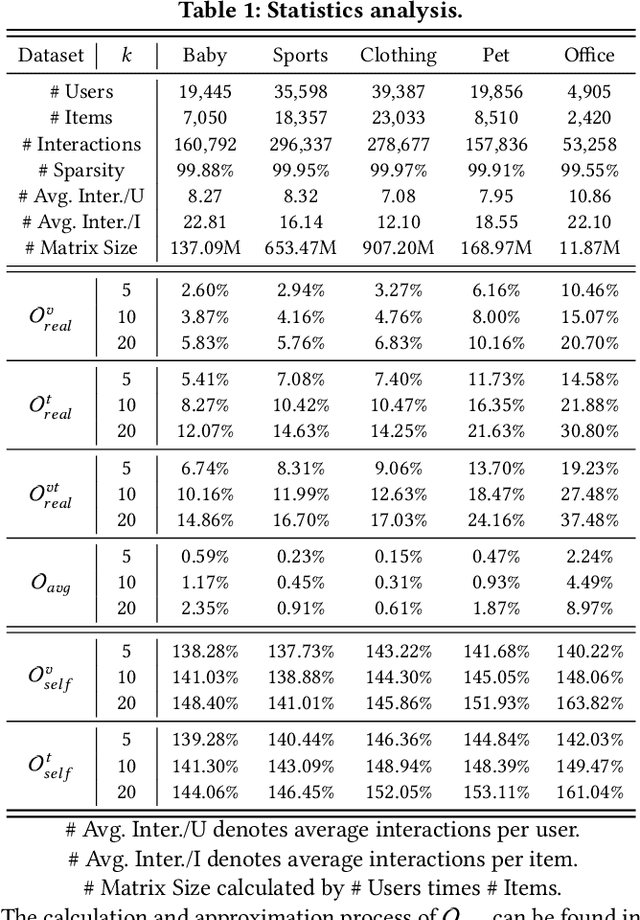
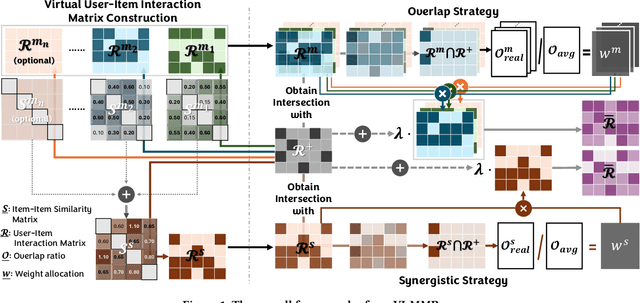
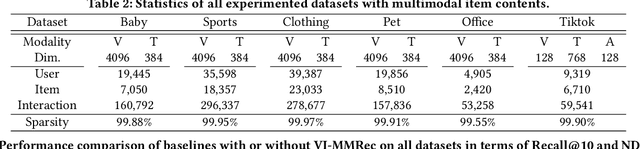
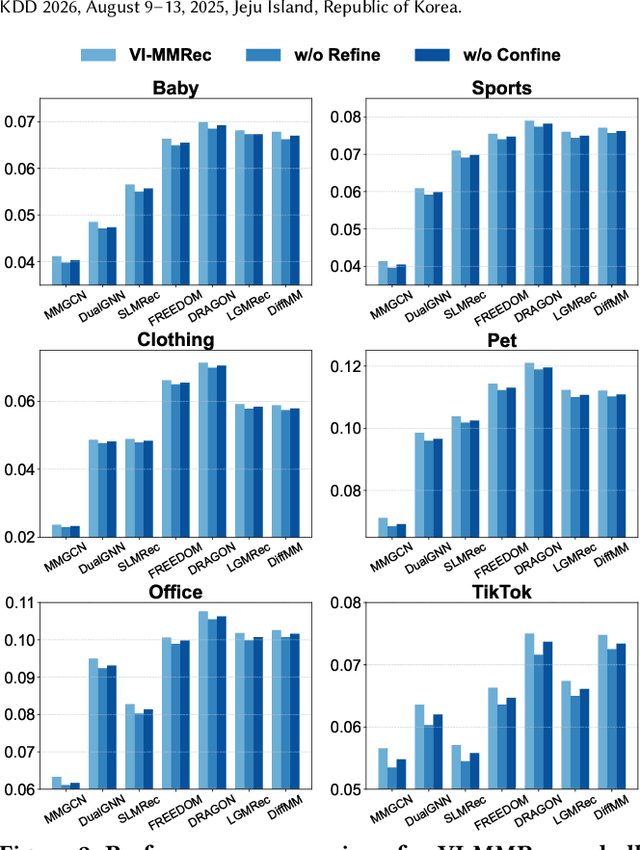
Although existing multimodal recommendation models have shown promising performance, their effectiveness continues to be limited by the pervasive data sparsity problem. This problem arises because users typically interact with only a small subset of available items, leading existing models to arbitrarily treat unobserved items as negative samples. To this end, we propose VI-MMRec, a model-agnostic and training cost-free framework that enriches sparse user-item interactions via similarity-aware virtual user-item interactions. These virtual interactions are constructed based on modality-specific feature similarities of user-interacted items. Specifically, VI-MMRec introduces two different strategies: (1) Overlay, which independently aggregates modality-specific similarities to preserve modality-specific user preferences, and (2) Synergistic, which holistically fuses cross-modal similarities to capture complementary user preferences. To ensure high-quality augmentation, we design a statistically informed weight allocation mechanism that adaptively assigns weights to virtual user-item interactions based on dataset-specific modality relevance. As a plug-and-play framework, VI-MMRec seamlessly integrates with existing models to enhance their performance without modifying their core architecture. Its flexibility allows it to be easily incorporated into various existing models, maximizing performance with minimal implementation effort. Moreover, VI-MMRec introduces no additional overhead during training, making it significantly advantageous for practical deployment. Comprehensive experiments conducted on six real-world datasets using seven state-of-the-art multimodal recommendation models validate the effectiveness of our VI-MMRec.